A new study led by Sorbonne University Abu Dhabi (SUAD), in collaboration with the Environment Agency – Abu Dhabi (EAD), the emirate's environmental regulator, and the Muséum national d'Histoire naturelle (MNHN), France's national museum of natural history in Paris, revealed distinct biodiversity patterns, particularly across mangrove and, to a lesser extent, seagrass habitats within one of the world's most urbanised coastlines.
The research, published in the scientific journal PLoS ONE, represents the first environmental DNA (eDNA)-based survey of marine vertebrates in Abu Dhabi. Researchers detected 83 vertebrate taxa across four urban coastal sites, including 75 bony fish, two sharks and rays, one marine mammal and five birds. Of these, 22 were identified to species level.
The Arabian Gulf is one of Earth's most challenging marine environments, with shallow, semi-enclosed waters that exceed 35°C in summer and are considerably saltier than the open ocean. Despite these demanding conditions, the Gulf supports ecologically important habitats and marine species that have adapted to exceptionally high temperatures and salinity. Understanding the impacts of ongoing environmental changes on marine life requires studying highly demanding ecosystems — places where species are already living at the very edge of their tolerance. The Arabian Gulf, with its exceptional heat, hypersalinity, and intense human pressures, is one of those places: a natural laboratory that shows us today what many other seas may face tomorrow. This is precisely why rigorous and continuous monitoring is both a scientific priority and a responsibility.
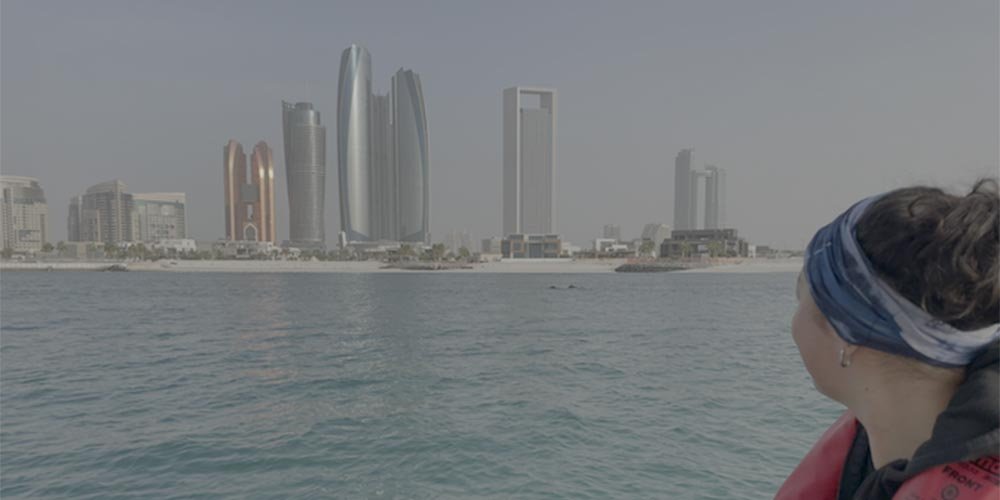
The study examined four contrasting coastal environments in December 2024: Mangrove National Park, a seagrass bed near Al Futaisi Island, Marsa Al Bateen marina and Al Hudayriyat Channel. The mangrove and seagrass habitats showed higher levels of phylogenetic diversity, a measure that considers not only the number of species present but also how evolutionarily distinct they are from one another. This indicates that these habitats, support more diverse fish lineages than recently developed sites, offering a preliminary signal of their potential ecological role within Abu Dhabi's highly developed coastal environment. In comparison, the recently developed Al Hudayriyat Channel recorded lower phylogenetic diversity, suggesting a marine community still in formation, while Marsa Al Bateen marina fell between the mangrove habitats and the recently developed site.
The findings form part of the doctoral research of Rachel Haderlé at MNHN, supervised by Dr Jean-Luc Jung Professor at MNHN and Visiting Scholar at SUAD's Ocean Institute, whose research has notably advanced the way eDNA-based biodiversity inventories are analysed and exploited in terms of biodiversity metrics.
Like a fingerprint in the water, environmental DNA (eDNA) allows researchers to identify organisms through traces of DNA they naturally release into their surroundings, including through skin cells, mucus, scales or excrement. By filtering water in controlled conditions and using high-throughput sequencing to analyse these traces, researchers can build a snapshot of local biodiversity without capturing, disturbing or even seeing the animals.
The technique combines three important qualities: it is non-invasive, integrative and requires relatively little at-sea effort. Using a single protocol, researchers can analyse a water sample to simultaneously detect fish, sharks, dolphins and even birds, while rigorous sampling protocols are critical to ensuring the quality of the data.
Dr Jean-Luc Jung, Professor at MNHN and Visiting Scholar at SUAD's Ocean Institute, said: "These results call for caution and vigilance. We cannot conclude from this single study that Abu Dhabi's mangroves and seagrass beds are thriving biodiversity hotspots — we have no pristine reference ecosystem to compare against. What we can say is that, despite being surrounded by an intensely developed city, these habitats still appear to support a structured and diverse fish community. That is a signal we should not ignore: they likely play a critical role, and we risk losing it before we fully understand it."
The research combined SUAD's scientific leadership with MNHN's expertise in eDNA and molecular taxonomy and EAD's extensive knowledge of Abu Dhabi's marine ecosystems. EAD identified the sampling sites, provided a small EAD boat and crew, and supported the fieldwork and relevant permitting, with four of its scientists contributing as co-authors.
Maitha Mohamed Al Hamedli, Acting Executive Director, Terrestrial and Marine Biodiversity of EAD said: "This study strengthens our understanding of biodiversity across Abu Dhabi's coastal ecosystems and demonstrates the value of eDNA as a powerful tool for marine monitoring. Supported by EAD's research vessels and our long-term monitoring programmes, this research brings together advanced science and local expertise to track ecological change and guide effective conservation and management decisions."
The study marks the first campaign of the MARVEL programme (Marine Vertebrate eDNA Long-term monitoring, UAE), a multi-year initiative led by SUAD's Ocean Institute in partnership with MNHN and EAD. Two further campaigns were completed in August and December 2025, with comparisons across other UAE coastal ecosystems planned to build a broader picture of marine vertebrate diversity over time. All biodiversity data from the research are freely available through the Global Biodiversity Information Facility (GBIF) under an open licence.